“One of the estimates that I think is most likely is that data centers will require an additional 29 gigawatts of power by 2027, and 67 more gigawatts by 2030.”
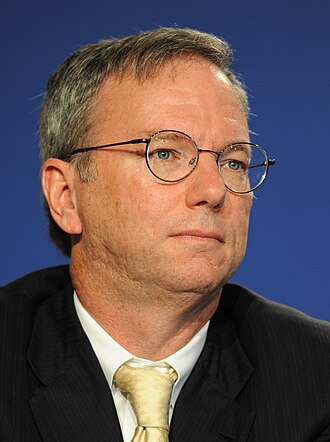
Former CEO and Chairman of Google; Chair of the Special Competitive Studies Project
Deadline is the end of 2027; Schmidt framed the figure as the estimate he considered most likely, immediately after noting that "many people think" the industry's share of US generation could go from 3% to 99%.
“The danger arrives at "the point at which the computer can start to make its own decisions to do things" — when, say, such a system discovers access to weapons and we can't be certain the system will tell us the truth. Two years ago that moment was expected to be 20 years off; today some experts think it's only two to four years away.”
Former CEO and Executive Chairman of Google; Chair of the Special Competitive Studies Project
Schmidt relayed the two-to-four-year estimate as the view of 'some experts'; at the same event he separately warned that company guardrails 'aren't enough' against capabilities that could endanger humanity in five to 10 years.
“Clearly agents with the capacity I've described will occur in the next few years. There won't be one day when we realize "Oh, my God." It is more about the cumulative evolution of capabilities every month, every six months and so forth. A reasonable expectation is that we will be in this new world within five years, not 10.”
Former CEO and Executive Chairman of Google
The 'new world' Schmidt describes is the convergence of very large context windows, autonomous agents and text-to-action capability.
“Recursive self improvement is when it's learning on its own. This is not true today. Today, when you set up one of these huge data centers, you have to tell it to learn. But the belief is that this is coming — within four years.”
Former CEO of Google; chair of the Special Competitive Studies Project and CEO of Relativity Space
Deadline is end of 2029. The Crimson reports the timeline as four years; other write-ups of the same talk render it as 'two to four years,' so four years is the generous reading. Schmidt added that AI generating medical conjectures and discovering new facts 'looks like it's very close.'
“Within 3 to 5 years we'll have what is called general intelligence, AGI, which can be defined as a system that is as smart as the smartest mathematician, physicist, artist, writer, thinker, politician. I call this the San Francisco consensus, because everyone who believes this is in San Francisco.”
Former CEO and Chairman of Google; Chairman of the Special Competitive Studies Project
Outer bound of the 3–5 year window falls in April 2030. Schmidt has since restated a similar timeline (AGI around 2028–2030, superintelligence within a decade) at the RAISE Summit in Paris in July 2025.
“It is reasonable to predict that we are going to have specialized AI savants in every field within five years. Now imagine their capabilities and how they will change society and our day-to-day lives.”
Former CEO and Executive Chairman of Google; co-founder of Schmidt Sciences
Made alongside Schmidt's argument that electricity, not chips, is AI's natural limit; distinct from his separate 'AGI in three to five years' claim in that it concerns domain-specialized savants rather than general intelligence.
“The computers are now doing self-improvement... they don't have to listen to us anymore. We call that superintelligence or ASI — computers that are smarter than the sum of humans. The San Francisco consensus is this occurs within six years.”
Former CEO and Chairman of Google; Chairman of the Special Competitive Studies Project
Six years from April 2025 puts the deadline at April 2031; contemporaneous reporting rendered this as artificial superintelligence 'by 2031.'
“Predictions that a billion jobs will be lost in the next decade because of AI are "almost certainly false": "There's no question there's job losses, but for every job loss, there's probably more than one job created. There'll be more jobs created than jobs lost."”
Former CEO and Chairman of Google; CEO of Relativity Space
Resolves on whether AI-driven job losses approach the scale critics predicted and whether AI is a net job creator over the decade to 2035.
“We believe as an industry that in the next one year the vast majority of programmers will be replaced by AI programmers.”
Former CEO and Chairman of Google; Chairman of the Special Competitive Studies Project
The one-year deadline passed in April 2026 without anything resembling mass replacement of programmers. AI coding agents were adopted broadly and write a large and growing share of code, but human software developers remained employed in the millions and no 'vast majority' displacement occurred.
“We also believe that within one year you will have graduate-level mathematicians that are at the tippy top of graduate math programs.”
Former CEO and Chairman of Google; Chairman of the Special Competitive Studies Project
AI math ability advanced dramatically within the window — gold-medal-level International Mathematical Olympiad performance in July 2025 and rapid gains on research-level math benchmarks and formal proof work — but by April 2026 systems had not generally matched top graduate students across open-ended research mathematics, so the claim is only partly borne out.
“In the next year, you're going to see very large context windows, agents and text action. When they are delivered at scale, it's going to have an impact on the world at a scale that no one understands yet. Much bigger than the horrific impact we've had by social media in my view.”
Former CEO and Executive Chairman of Google; chair of the Special Competitive Studies Project
The three technical ingredients did arrive within the year: million-token context windows became standard (Gemini, Claude, Llama 4), and agentic/computer-use and coding agents shipped broadly through 2024-2025. But the claimed societal impact 'much bigger than social media' had not materialized by 2025 — the technology arrived, the world-scale disruption did not.
“Say to your LLM the following: Make me a copy of TikTok, steal all the users, steal all the music, put my preferences in it, produce this program in the next 30 seconds, release it and in one hour, if it's not viral, do something different along the same lines. That's the command... Imagine that each and every human on the planet has their own programmer that actually does what they want... That's all within the next year or two.”
Former CEO and Executive Chairman of Google; chair of the Special Competitive Studies Project
By 2026 'vibe coding' platforms (Lovable, Base44, Replit Agent, Claude Code, Codex) do let ordinary users generate working apps — including social-video clones — from a prompt in minutes, so the 'everyone has their own programmer' part broadly arrived. But no system executes the described loop: no 30-second production-grade TikTok replica, no ingesting of a rival's users and music catalog, and no autonomous relaunch-until-viral iteration.
“The 2024 elections are going to be a mess because social media is not protecting us from false generated AI. They're working on it, but they haven't solved it yet.”
Former CEO and Chairman of Google; co-founder of Schmidt Futures
Said Jun 26, 2023Deadline Nov 5, 2024CNBC 'Squawk Box', June 26, 2023 Platforms did cut trust-and-safety staff as Schmidt warned, but the 2024 US election was not the AI-driven 'mess' he predicted: retrospectives from the Harvard Ash Center and the Knight First Amendment Institute concluded the feared AI misinformation wave had marginal effect on the vote, with non-AI fakes far more prevalent.